26/02/2026 0 Comments
Why District Heating Is More Efficient Than Individual Heat Pumps & the Role of Advanced Flexible Pipe Systems
As cities move toward decarbonization and energy resilience, one question keeps surfacing:
Should we rely on individual heat pumps, or invest in district heating networks?
While both technologies are essential to the energy transition, district heating systems often deliver higher system-wide efficiency, especially in dense urban developments. The difference comes down to scale, energy sourcing, infrastructure optimization — and critically, the pipe technology that connects it all.
As cities move toward decarbonization and energy resilience, one question keeps surfacing:
Should we rely on individual heat pumps, or invest in district heating networks?
While both technologies are essential to the energy transition, district heating systems often deliver higher system-wide efficiency, especially in dense urban developments. The difference comes down to scale, energy sourcing, infrastructure optimization — and critically, the pipe technology that connects it all.
The Efficiency Advantage of District Heating
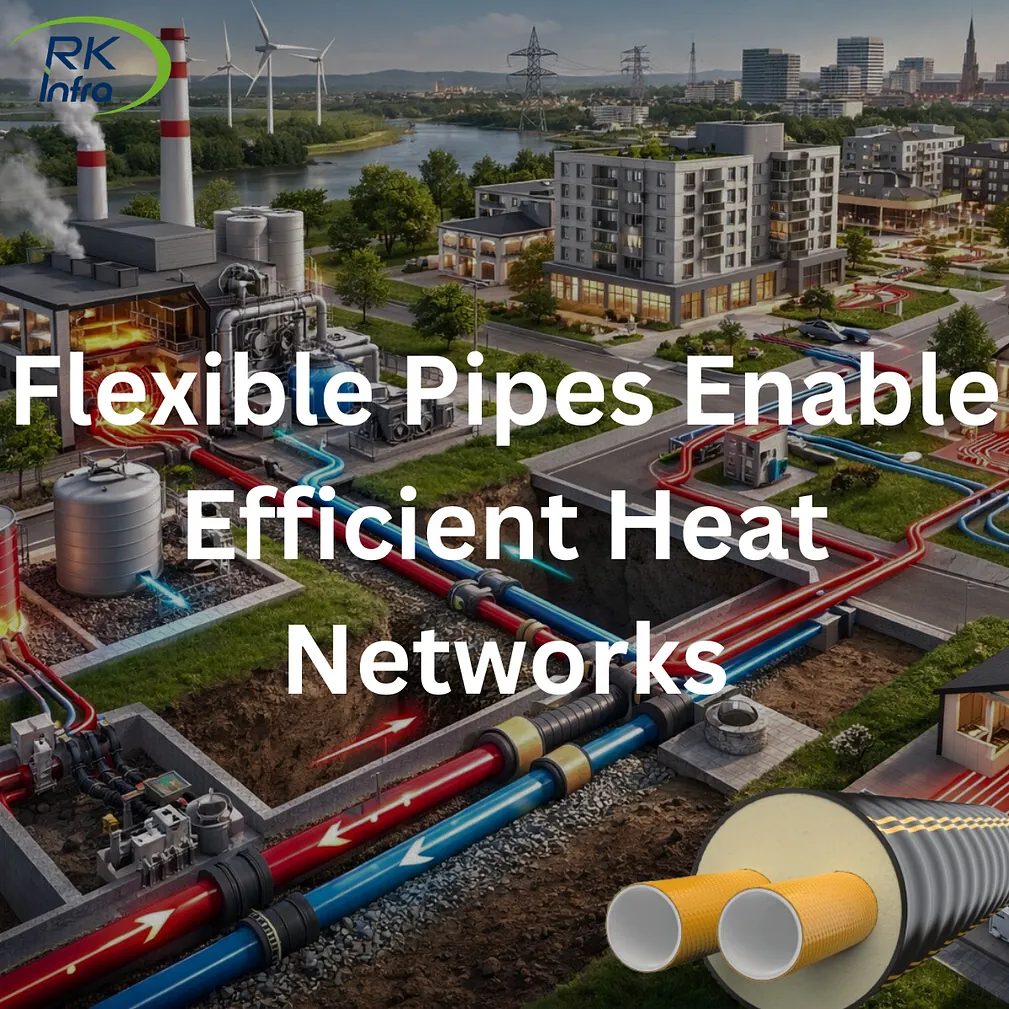
District heating distributes thermal energy from a centralized plant to multiple buildings through insulated underground pipes. This centralized approach unlocks efficiencies that individual systems cannot match.
1. Better Energy Utilization Through Scale
Large plants can use energy sources unavailable to individual buildings, including:
- Industrial waste heat
- Combined heat and power (CHP) plants
- Geothermal energy
- Large-scale renewable heat
- Waste-to-energy facilities
- Because production is centralized, operators can optimize fuel use and emissions control far more effectively than thousands of small systems. District heating plants can achieve higher efficiencies and better pollution control than localized boilers.
In contrast, individual heat pumps depend heavily on electricity availability and building-specific conditions.
2. Lower Infrastructure and Electrical Demand
In dense developments, installing individual heat pumps in every building can strain electrical infrastructure and require extensive upgrades.
District heating networks avoid this problem by delivering thermal energy directly. For medium- and high-density projects, heat networks are often preferred due to lower electrical infrastructure requirements and better space efficiency.
This is especially relevant in rapidly growing cities and mega-projects.
3. Superior Performance in Urban Environments
Research consistently shows district heating outperforming individual solutions in cities.
- District heating can be significantly cheaper than individual heat pumps in densely populated urban areas.
- Annual heating costs may be up to 30% lower than individual water-source heat pumps in some cases.
- Efficiency improves further when networks integrate waste heat or renewable sources.
4. Future-Proof Integration with Renewable Energy
District heating networks can absorb excess renewable energy, store heat, and redistribute it when needed — something individual systems cannot do efficiently.
Large heat storage and cogeneration allow operators to run plants at optimal times and balance fluctuating energy supply.
This makes district heating a cornerstone of smart, resilient energy systems.
Where Individual Heat Pumps Still Make Sense
To be clear: heat pumps are highly efficient at the building level, often producing multiple units of heat per unit of electricity.
They are ideal for:
- Low-density housing
- Remote areas without networks
- Retrofit projects where district heating is unavailable
But for cities, campuses, and large developments, district systems usually deliver greater overall efficiency.
The Hidden Factor: Pipe Infrastructure
Efficiency doesn’t stop at the plant.
The distribution network, particularly the pipe system, determines:
- Heat loss
- Installation cost
- Reliability
- Construction speed
- Lifetime performance
- Modern district heating requires flexible, high-performance piping solutions capable of handling complex routing, urban constraints, and long-term durability.
This is where advanced flexible pipe technologies like RK Infra’s Fibreflex and Fibreflex Pro come into play.
How RK Infra Fibreflex Systems Enable Efficient District Heating
Fibreflex: Flexibility Meets Thermal Performance
Fibreflex pipes are designed to simplify installation while maintaining high insulation performance.
Key advantages:
- Reduced installation time due to flexibility
- Fewer joints → lower risk of heat loss and leakage
- Ability to navigate tight urban spaces
- Suitable for complex network layouts
- By minimizing connection points and excavation requirements, flexible pipes help preserve the efficiency gains achieved at the production level.
Why Pipe Technology Matters More Than Ever
As district energy systems evolve toward lower temperatures, renewable integration, and smart controls, infrastructure quality becomes critical.
Poor distribution design can erase efficiency gains from advanced plants.
High-performance flexible piping helps:
- Reduce thermal losses
- Acceler deployment timelines
- Lower lifecycle costs
- Improve system reliability
- In short, the pipe network is not just infrastructure, it’s a performance driver.
Conclusion: Efficiency Is a System, Not a Device
The debate between district heating and individual heat pumps misses a key point:
Efficiency must be evaluated at the system level, not just the building level.
District heating delivers its strongest advantages when supported by:
- Smart energy sources
- Optimized network design
- Advanced distribution technology
- Solutions like RK Infra’s Fibreflex and Fibreflex Pro help turn theoretical efficiency into real-world performance, enabling cities to scale sustainable heating faster and more reliably.

Comments
Leave a comment