31/03/2026 0 Comments
The Durability Myth: Why Flexible Pipes Outperform Rigid Systems in Real-World Conditions
In infrastructure and industrial construction, durability is often associated with rigidity. Steel and concrete systems are traditionally perceived as stronger simply because they are solid and immovable.
However, this assumption overlooks a critical reality: infrastructure does not operate in static environments.
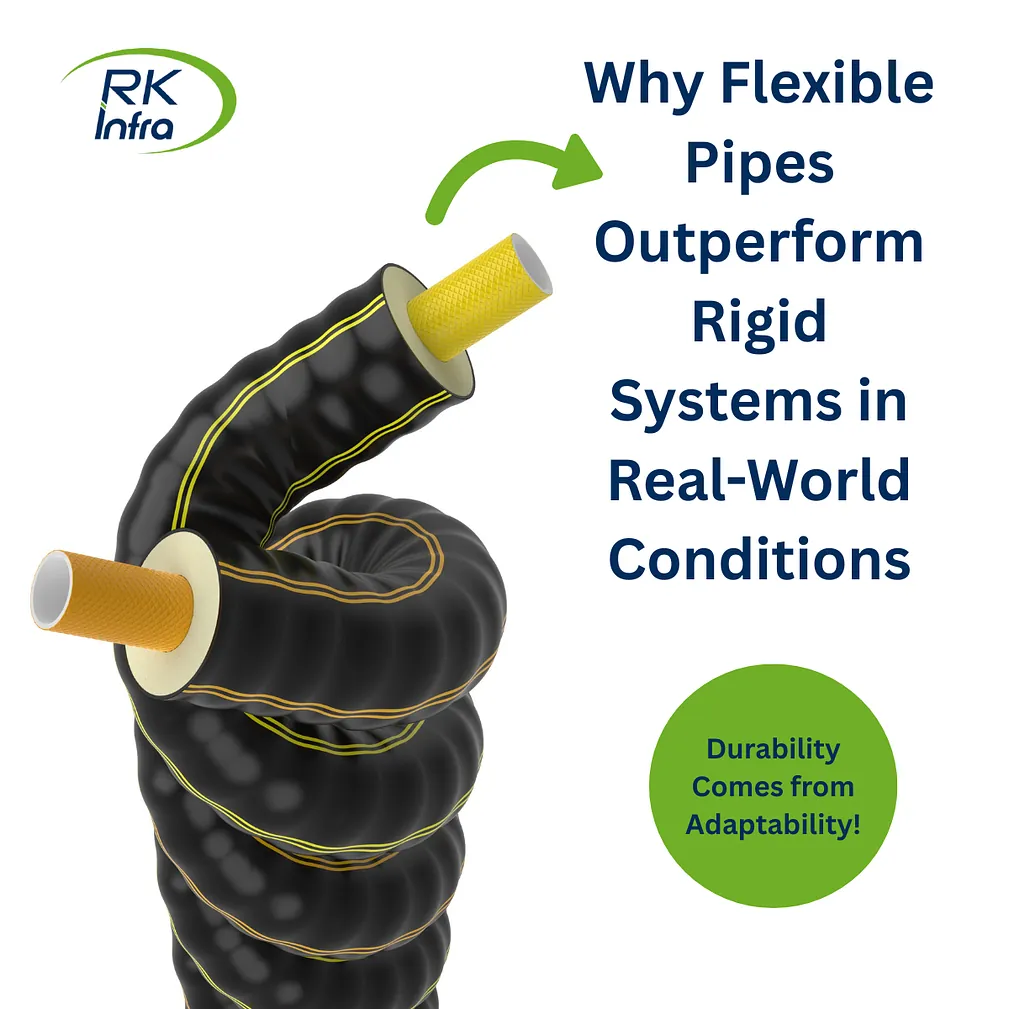
Flexible pipe systems such as Fibreflex and Heatflex are specifically engineered to perform under dynamic conditions — making them, in many cases, more durable than rigid alternatives.
Reality: Durability Comes from Adaptability
Flexible piping systems are designed to handle three major stress factors that commonly cause failure in rigid systems:
1. Ground Movement
Soil is not stable. Over time, infrastructure is exposed to:
- Settlement
- Vibrations (traffic, machinery)
- Seasonal ground shifts
Rigid pipes:
- Cannot adapt to movement as well
- Experience stress concentration at joints
- Are more prone to cracking and leakage
Flexible pipes:
- Absorb and distribute movement
- Reduce stress points
- Maintain structural integrity over time
2. Temperature Fluctuations
Thermal expansion and contraction are major challenges, especially in district heating systems.
Rigid systems:
- Expand and contract with limited tolerance
- Require expansion joints and complex design considerations
- Are vulnerable to fatigue over time
Flexible systems:
- Naturally accommodate thermal changes
- Require fewer additional components
- Maintain performance across temperature cycles
3. Pressure Variations
Operational pressure is rarely constant in real systems.
Rigid pipes:
- Handle pressure well under stable conditions
- Become vulnerable under repeated fluctuations
Flexible pipes:
- Absorb pressure variations more effectively
- Reduce long-term material fatigue
- Provide consistent performance under variable loads
- Reduced Failure Points
One of the biggest durability advantages of flexible systems is design simplicity:
- Fewer joints
- Continuous pipe lengths
- Lower risk of leakage
- Since most failures occur at connection points, reducing these significantly increases system lifespan.
Long-Term Performance and Lifecycle
When evaluating durability, short-term strength is less important than long-term reliability.
Flexible systems offer:
- Lower maintenance requirements
- Reduced repair frequency
- Longer operational lifespan when properly installed
This makes them not only technically reliable but also economically advantageous.
Conclusion
The idea that rigidity equals durability is outdated.
In modern infrastructure, the ability to adapt to environmental and operational stress is what defines long-term performance.
Flexible pipe systems demonstrate that:
Flexibility is not a compromise — it is a strategic advantage.
At RK Infra, selecting the right system is not about tradition, but about performance under real conditions.

Comments
Leave a comment